Efficiency
A thermal bridge is a shortcut through the insulation
Heat concentrates wherever the path conducts best, so a small area of poorly insulated structure carries far more loss than its size suggests, and it is where mould appears first.
By Manish Trivedi4 min read
Heat takes the easiest path, not the average one
Imagine a wall as several routes running side by side from inside to outside. Heat divides between them according to how easily each conducts, which means a small area of high conductance takes a disproportionate share of the building’s losses. This is why averaging across a wall is misleading, and why the arithmetic of insulation rarely matches the arithmetic of buildings.
The image people carry is of heat seeping evenly through a surface. The reality is closer to water finding a crack. Put a well-conducting element through an otherwise resistant layer and the flow concentrates there, in the same way current concentrates in the low-resistance branch of a parallel circuit.
That concentration has two consequences, and they are different problems. One is energy: the loss is larger than the area implies. The other is temperature: the inside surface at that point runs colder than the surface around it, and cold surfaces attract water.
Where the bridges are in an ordinary house
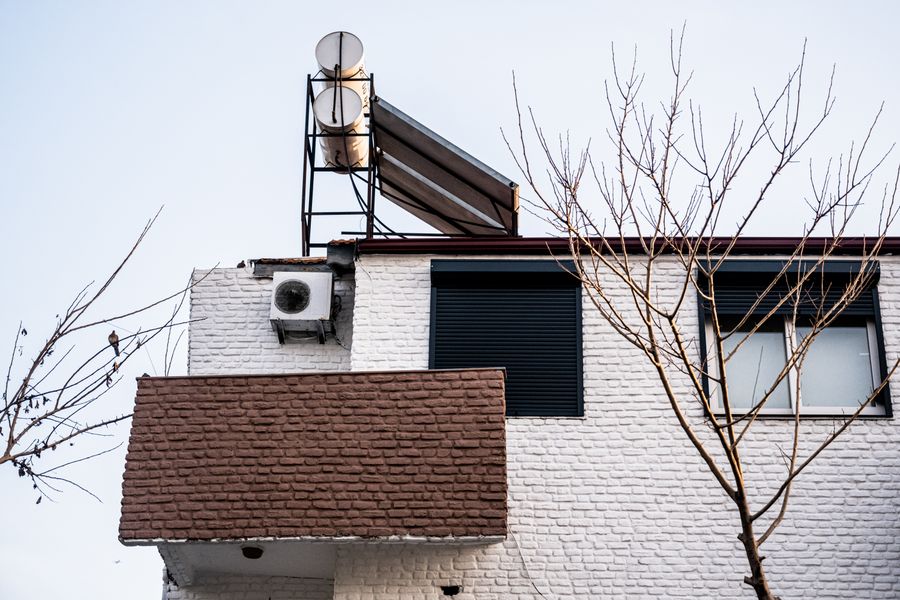
The usual suspects are structural. Lintels over windows, the reveals around openings, the junction where a wall meets a floor or a roof, joist ends built into an external wall, and any steel or concrete element that passes from the warm side to the cold. Balconies formed as a continuation of a floor slab are the extreme case.
Then there are the ones created by convenience. A loft hatch with no insulation on it, a run of pipes or cables through the envelope, an extractor duct, a recessed light fitting punched through a ceiling. Individually small; collectively, in a house with plenty of them, not small at all.
And there is a category that only exists in attached housing, where an unsealed party wall cavity can behave as a chimney, drawing air up from the ground and out at the roof. It is invisible from either side and it defeats the insulation on both.
Some bridges repeat, and those are the ones that dominate
A distinction worth having is between isolated bridges and repeating ones. A single steel column is isolated. Timber studs at regular centres, or rafters in a roof, are repeating, and they occupy a meaningful fraction of the total area while conducting considerably better than the insulation between them.
A figure quoted for an insulation product isn’t a figure for the wall it goes into. The assembly includes the frame, and a calculation that accounts for it produces a worse number than the brochure. Reputable design does this as a matter of course; informal estimates frequently do not.
It also explains a common disappointment. A household insulates thoroughly, expects a transformation, and gets an improvement. Once the easy surfaces are resistant, whatever remains conductive becomes proportionally more important than it was.
The cold surface is often the bigger problem
Air holds a limited quantity of water vapour, and the limit falls as temperature falls. A surface running several degrees colder than its surroundings will therefore reach the point of condensation while the rest of the room is comfortably dry, which is why mould grows in a line along a wall or in a rectangle around a window.
That pattern is diagnostic. A stripe of mould near the ceiling of an outside wall generally marks the wall plate or a joist. Mould in the corners marks the geometric bridge, where two cold surfaces meet and the inside area is small relative to the outside. You don’t need equipment to read this.
Thermal imaging in cold weather makes it visible more precisely, though the images are misread constantly. Surface temperature depends on emissivity and on what the surface has recently been exposed to, and a striking picture is not by itself a diagnosis.
Retrofit creates bridges about as often as it removes them
Insulate a wall internally and stop at the window opening, and the reveal becomes a bridge that was not one before, because the surrounding surface is now warmer and the reveal is not. The same happens where new insulation meets an extension built to a different standard, or where a lined wall meets an uninsulated floor.
This is the awkward truth about improving a building in stages, which is how nearly all of it happens. Each improvement raises the relative importance of whatever was not improved. That is not an argument against staged work; it is an argument for planning the junctions before the work starts rather than discovering them afterwards.
Returning insulation into reveals, insulating a loft hatch, sealing service penetrations and closing a party wall cavity are all comparatively cheap. They are also the ones most often skipped, being fiddly and invisible on any specification.
Which bridges are worth chasing
The cheap ones, mostly. A loft hatch, a poorly fitted extractor, an insulated reveal, a gap at the eaves — these take an afternoon or a small quotation and remove both the loss and the damp patch. The improvement is modest in energy and can be substantial in comfort, which is what people actually notice.
Structural bridges are usually a different matter. You cannot remove a steel beam, and interrupting a floor slab that continues outside is major work justified by a full refurbishment rather than by an energy calculation. It is entirely reasonable to identify such a bridge, understand it, and decide to live with it.
The exception is where a bridge is causing persistent mould rather than merely losing heat, because that is a building health problem rather than an energy one. Where internal insulation is being considered as the remedy, the moisture behaviour of the whole construction needs designing properly, and that is a job for a specialist rather than a weekend.
Common questions
Can I find thermal bridges without a thermal camera?
Often, yes. Cold spots are detectable by hand on a cold day, and the distribution of mould and dust marking on walls follows the bridges reliably. A camera adds precision and a great deal of false confidence, so if you hire one, do it on a genuinely cold morning after the heating has been running steadily.
Does insulating over a bridge fix it?
Partially. A continuous layer of insulation over the whole surface, inside or out, reduces every path including the conductive one, which is why external wall insulation performs so well when it is detailed properly. Coverage is the point: wherever the layer stops or is interrupted, the bridge reappears at that edge.
Is condensation on a cold surface always a bridging problem?
No, and treating it as one leads people to expensive remedies for a ventilation issue. Persistent high humidity from drying laundry indoors, cooking or a blocked extractor will produce condensation on any cool surface. If the pattern is localised and repeatable, a bridge is likely; if it is everywhere, look at moisture and airflow first.
Deputy editor, Power Your Roof
Manish has been reporting on solar basics, batteries, bills & tariffs since long before it was fashionable and would rather show the working than assert the conclusion.