Solar Basics
Why the optimum tilt for an array is flatter than people expect
The old rule of setting tilt equal to latitude optimises for one moment in the year, and annual energy prefers something shallower.
By Daniel Okonkwo4 min read
The rule everybody repeats
Somewhere in the first hour of reading about solar you will meet the instruction to set the array tilt equal to your latitude. It is an old rule, it is not exactly wrong, and it is worth knowing what it optimises before deciding whether to follow it. A panel tilted at the local latitude points squarely at the midday sun on the two equinoxes, which is a tidy and memorable property.
The trouble is that annual energy is not decided at the equinox. It is the sum of everything the panel receives across several thousand daylight hours, weighted by how much light was available in each of them. Worked out for a real location with real weather, the tilt that maximises that sum usually lands several degrees below the latitude, and in a cloudy maritime climate it can be flatter still. None of which makes the rule useless. It answers a question about geometry, and the question being asked on a roof is about energy.
Cosine losses are gentle near the peak
Direct sunlight delivers power to a panel in proportion to the cosine of the angle between the sun and a line drawn perpendicular to the glass. That is the whole of the geometry. The useful part is the shape of the cosine curve near zero, which is remarkably flat, and that flatness is what makes solar siting far more forgiving than it first appears.
Work a few values through. Ten degrees off perfect alignment costs about one and a half per cent of the beam. Twenty degrees costs a little over six per cent. Thirty degrees costs roughly thirteen. The penalty is negligible until quite suddenly it is not, and since the sun sweeps through a large arc every day and a larger one across the year, no fixed panel stays aligned for long anyway.
So the optimum is a broad plateau rather than a sharp peak, and across most of the mid-latitudes any tilt between about fifteen and forty degrees lands within a few per cent of the best annual yield available at that site.
Diffuse light has no direction to be aimed at
Not all the light reaching a roof arrives as a beam from the sun. A substantial share has been scattered by air molecules, water droplets and dust, and arrives from across the whole sky. Under heavy overcast essentially all of it has, which is why a panel still produces on a grey afternoon.
Diffuse light behaves differently in one way that matters here. It cannot be aimed at, so what decides how much a panel collects is simply how much of the sky it can see. A horizontal panel sees the entire hemisphere above it. Tilt that panel and it trades part of its view of the sky for a view of the ground, and the ground reflects a good deal less than the sky supplies.
Diffuse light therefore pulls the optimum tilt towards flat, and it pulls harder the cloudier the climate. In a dry, clear location where most irradiance arrives as direct beam, the geometry dominates and the classic rule sits closer to right. In northern Europe, in a monsoon climate, or anywhere with persistent haze, the flattening is real and worth several degrees.
Winter sun is expensive to chase
The instinctive case for a steep tilt is that it catches the low winter sun, and winter is when a household draws most energy. Both halves of that are true, and the conclusion still often fails, simply because there is so little energy there to catch.
Two effects work against the winter sun at once. It sits low, so its light travels a much longer path through the atmosphere and arrives attenuated by scattering along the way. And the days are short. The Earth sits marginally closer to the sun in January than in July, which adds a few per cent by plain inverse-square arithmetic, but that is a small counterweight against a much larger geometric one.
Steepening the array buys a proportional gain on a small quantity and pays for it with a loss across the summer months, where most of the annual total lives. If the system is grid-connected and a unit is worth about the same in any month, that trade rarely comes out ahead. If it is off-grid and December sizes everything, it comes out ahead easily. Same physics, different objective.
What really decides the angle on a real roof
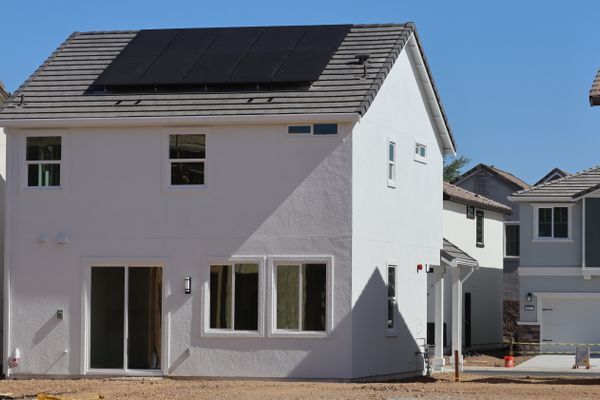
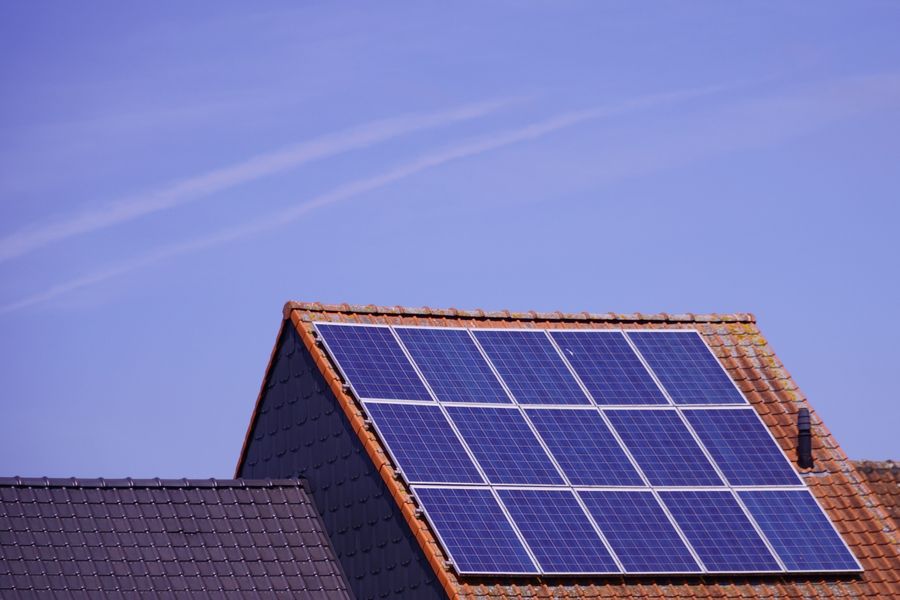
On a pitched roof the argument is largely academic, because flush mounting is what happens and the pitch is what it is. Tilt frames that lift panels off a slope do exist, and they add wind loading, cost and shading between rows, and they are seldom justified by the few per cent they recover.
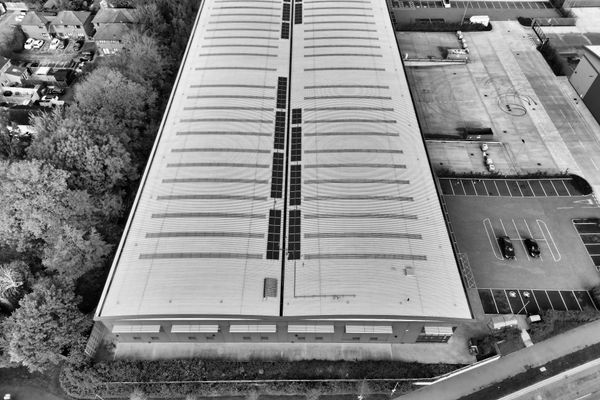
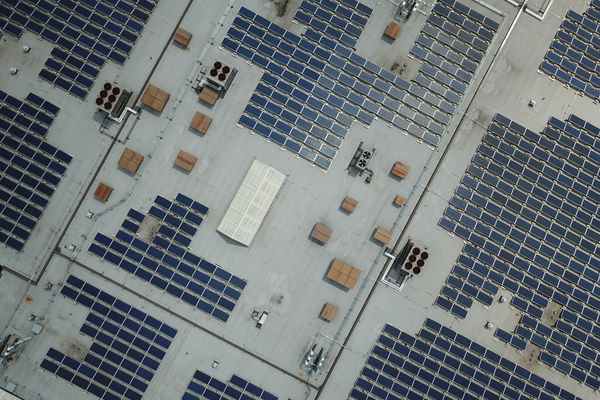
A flat roof is where the choice is real, and there the answer is usually flatter than a first-principles calculation suggests. Shallow tilt means rows shade each other less, which means they can sit closer together, which means more panels fit on the roof. More capacity at slightly lower yield per panel commonly beats less capacity at the theoretical optimum. Wind uplift also grows steeply with tilt, and uplift becomes ballast, and ballast becomes structural load on a deck that was not designed for it.
There is a floor, though. Below roughly ten degrees, rain stops running off decisively, and dust and bird lime accumulate instead of washing away. Where snow settles, a shallow panel holds it, and a panel under snow produces nothing whatsoever. Those are better reasons to resist going truly flat than the geometry is.
Common questions
Is a south-facing roof essential?
In the northern hemisphere it is the best single orientation and it is not a requirement. East and west facing arrays lose something in annual total but spread production across the morning and afternoon, which can suit a household that is out at midday. Mirror all of this in the southern hemisphere, where north is the equator-facing direction.
Should I pay for a tracker that follows the sun?
For a domestic rooftop, almost never. Trackers add moving parts, maintenance and mounting complexity to a structure that was built to be static, and the yield they recover on a house-sized array rarely covers that. They earn their keep in ground-mounted commercial installations where the economics of scale are different.
Does cleaning the panels help enough to bother?
It depends entirely on climate. Where rain is regular and the tilt is above about fifteen degrees, panels largely clean themselves and a paid clean is hard to justify. In a dusty or arid region, or under trees, or where birds roost nearby, soiling is a genuine and continuing loss worth addressing.
Editor, Power Your Roof
Daniel writes the explanatory pieces on solar basics, batteries, bills & tariffs and is unreasonably interested in the detail nobody else checks.