Solar Basics
Optimisers and microinverters fix different halves of the same problem
Both put electronics under every panel and both are sold as a shading remedy, but they split the work between roof and ground in ways that change cost, failure and design freedom.
By Daniel Okonkwo4 min read
Two devices, one underlying complaint
The complaint both products answer is the series string. When panels are wired in series, the weakest one limits the current for the whole chain, so shade, dirt, a different orientation or plain manufacturing variation on one module drags down the rest. Module-level electronics exist to break that dependency.
An optimiser is a small direct-current converter fitted to each panel. It runs maximum power point tracking for that panel alone, then adjusts its own output voltage and current so that the string can still carry a common current without penalising anyone. The string inverter stays, and still does the conversion to alternating current at ground level.
A microinverter goes further. It converts that panel’s output to alternating current on the roof, and panels are then connected in parallel on the AC side. There is no string inverter at all, and no high-voltage DC wiring running down through the building.
What per-module tracking actually recovers
The gain is real and it is specific. With per-module tracking, a shaded panel produces whatever the light allows and its neighbours produce whatever their light allows, independently. Mismatch stops propagating along the string.
That is the whole of the benefit, and it is worth being precise about the limit. Module-level electronics do not create light. A panel with a chimney shadow across it still makes very little; what you recover is the output the eleven unshaded panels were losing on its account. Where the shading is uniform across the array, there is nothing to recover, because there was no mismatch in the first place.
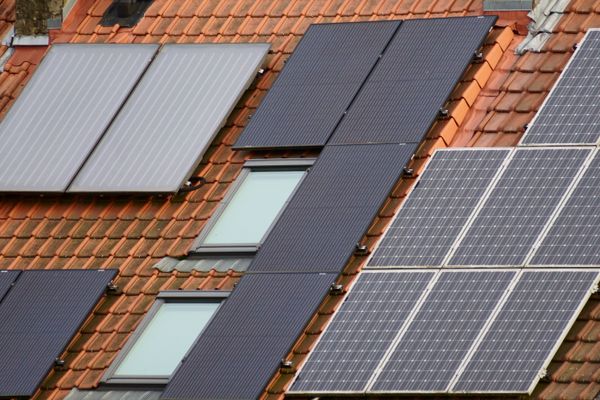
The same logic explains the other case where these devices genuinely earn their cost: a roof with panels facing more than one direction. East and west sections peak at different times, so on a single string one half is always holding the other back. Per-module tracking removes that entirely, and it is often a bigger practical gain than the shading argument that gets used to sell it.
The failure surface moves onto the roof
Every electronic component has a service life, and it is shortened by heat and by thermal cycling. Module-level electronics live in the worst thermal environment on the property: bolted to a rail directly beneath a panel that runs well above air temperature all summer, and cycling to ambient every night.
They are also inaccessible. A string inverter hangs on a wall in a garage or a utility room, and replacing one is a morning’s work with no scaffolding involved. An optimiser or microinverter that fails requires roof access, panel removal and, depending on the roof, edge protection or a tower. The unit itself may be inexpensive; getting to it is not.
Against that, the failure of one microinverter takes out one panel rather than the whole system, whereas a string inverter failure stops everything. Which risk profile suits you depends on how quickly you would notice, and monitoring at panel level is the thing that makes the difference between finding a fault and not.
Regulation and design freedom
In some jurisdictions the choice is partly made for you. Rules requiring rapid shutdown of rooftop DC conductors — motivated by firefighter safety — are satisfied naturally by module-level electronics, and require additional equipment otherwise. Where such rules apply, the comparison is not what it looks like elsewhere, so check what your local wiring standard demands before assuming a string inverter is the cheaper route.
There is design freedom too. String inverters impose constraints on how many panels can be wired together, driven by voltage limits on the coldest morning and by minimum start-up voltage on the dullest. Microinverters remove that arithmetic; you can fit three panels on an awkward dormer and add two more next year.
Optimisers sit in between, keeping the string inverter and therefore keeping some of its constraints, while relaxing others. They also generally cost less per panel than a full microinverter, which is a large part of why both products exist.
When neither is worth buying
On a clear roof with a single orientation and no obstructions, a plain string inverter is very likely the right answer. There is no mismatch to recover, so the money spent on module-level electronics buys monitoring detail and very little energy, while adding a component count on the roof that did not need to be there.
That is an unfashionable conclusion, because the extra hardware carries margin for whoever is selling it and the shading argument is easy to make persuasively. Ask the specific question instead: what is shading this array, when, and for how long? If the answer is nothing much, the electronics are optional.
Where the answer is a chimney, a flue, a dormer, a neighbour’s tree, or a roof that faces two ways, the calculation changes and these devices are straightforwardly good engineering. The mistake is treating them as a default upgrade rather than a targeted fix for a problem you can name.
Common questions
Can optimisers be added to an existing string system later?
Sometimes, but not freely. Optimisers generally have to be paired with a compatible inverter from the same ecosystem, so retrofitting often means replacing the inverter as well as fitting a unit under every panel. It is a substantially larger job than it sounds and rarely economic on its own.
Do microinverters waste energy converting on the roof?
Conversion efficiency is broadly comparable to a good string inverter, so that is not the main difference. What does differ is that many small converters each run at their own operating point, which helps at low light, while a single large one is generally more efficient at full load. The net effect is small either way.
Does panel-level monitoring justify the cost by itself?
For most households, no. It is genuinely useful for diagnosing a fault quickly and for spotting a failed bypass diode that a whole-system figure would hide, but useful is not the same as worth the difference in price. If you would not act on the data, you are paying for a dashboard.
Editor, Power Your Roof
Daniel writes the explanatory pieces on solar basics, batteries, bills & tariffs and is unreasonably interested in the detail nobody else checks.