Solar Basics
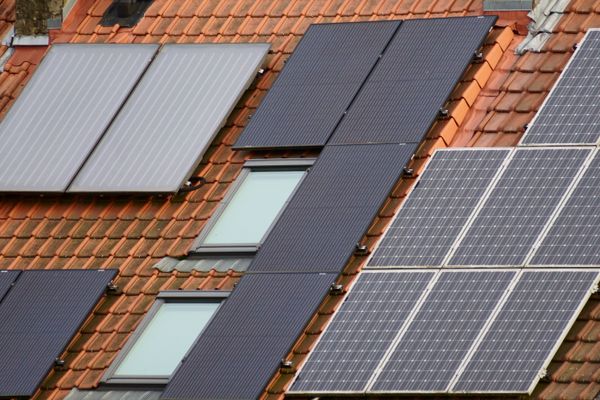
A solar thermal collector and a photovoltaic panel want the same roof
Heating water directly with sunlight is more efficient per square metre than making electricity, and that advantage is undone by the fact that electricity can do other things.
By Daniel Okonkwo4 min read
Two ways of using the same square metre
A solar thermal collector absorbs sunlight on a dark surface and carries the resulting heat away in a fluid, which then warms the water in a cylinder. A photovoltaic module converts a fraction of the same sunlight into electricity, which can be used for anything at all, including heating that same cylinder through an immersion element. Both occupy roof, both face the sun, and on most houses there is only enough good roof for one of them.
The comparison used to be straightforward and it is no longer, because the relative costs of the two technologies moved a very long way in one direction. What has not changed is the physics, and the physics still favours the collector on the narrow question it is good at. Understanding why that advantage stopped being decisive is the whole of this argument.
Heat is easier to make than electricity
A well-made flat plate or evacuated tube collector converts a large majority of the solar energy striking it into useful heat, because absorbing light and getting warm is close to the default behaviour of a dark object. The engineering is in the losses: the glazing, the insulation behind the absorber and, in an evacuated tube, the vacuum that removes convection from the equation entirely.
A photovoltaic cell is doing something much harder. It has to separate charge carriers across a junction, and the fraction of the spectrum it can use for that is inherently limited, so a commercial module converts a minority of the incoming energy and turns most of the rest into waste heat. That is not a defect. It is the price of producing a form of energy that can run a motor.
Per square metre, therefore, the collector wins on delivered energy by a wide margin. If your only need were hot water, and if the sun arrived when you wanted it, the argument would end there.
Electricity is worth more per unit because it can do anything
Heat in a cylinder can only ever become hot water. Electricity on a meter can become hot water, or it can run the fridge, or charge a car, or leave the house entirely and earn something on the way out. That flexibility is why a unit of electricity is priced well above a unit of heat, and why the collector’s efficiency advantage does not translate directly into a value advantage.
It also explains why a photovoltaic array with a diverter — a controller that sends surplus generation to an immersion element — has become the common answer to solar hot water. It is worse at heating water and better at everything else, and the everything else is where a modern household spends its energy.
This is a genuine trade rather than an equivalence, and anyone telling you the question is settled is skipping a step.
The cylinder is a hard ceiling on both of them
A house needs a fairly stable quantity of hot water each day, and the cylinder holds one day of it at most. Once the water in the tank is up to temperature, further solar heat has nowhere to go, and a thermal system in high summer routinely reaches that state by the middle of the morning.
That is called stagnation, and a well-designed system handles it safely, but it means the collector spends a large part of the sunniest months producing nothing at all. Sizing therefore works backwards from demand rather than from roof area, which is the opposite of how photovoltaic sizing usually proceeds.
The seasonal mismatch is worse still. Demand for hot water is roughly flat across the year while collector output follows the sun, so the system is oversupplied when nobody needs it and short in the months when the incoming mains water is coldest.
Where a thermal collector still makes clear sense
Households with unusually high and steady hot water demand are the strongest case: a large family, a guest house, anything with showers running throughout the day. Steady demand keeps the cylinder cool enough to keep absorbing, which is exactly the condition a collector needs to earn its area.
A second case is a house that already has a suitable cylinder with a spare coil and a heating system built around stored water. Adding a collector to that is a modest intervention. Adding one to a house with a combination boiler and no cylinder means installing the storage as well, and at that point the project is a heating rebuild rather than a solar installation.
Where it is hardest to justify is the ordinary two or three person household with limited roof and a modest daily draw. There, the same area given to photovoltaic modules produces something usable in every month, and the hot water can be picked up with a diverter as a by-product.
Two systems on one roof is rarely the compromise it looks like
Splitting the roof between technologies sounds like the sensible middle path, and mostly it isn’t. Each system carries its own fixed costs — access, mounting, controls, commissioning, a separate set of things to maintain — and dividing a small area between two of them means neither reaches a useful size while both sets of overheads are paid in full.
On a large roof with genuine surplus area and high hot water demand, it works perfectly well. On a typical house it is the arrangement most likely to disappoint.
Common questions
Does a solar thermal system work in winter?
It produces something on bright cold days, because the collector responds to light rather than to air temperature, and an evacuated tube design loses less of what it gathers in cold conditions than a flat plate does. But output follows daylight and sun angle, so the winter contribution is a preheat rather than a full supply, and the boiler or immersion still has to finish the job.
Can I have both a collector and photovoltaic panels?
Yes, and on a roof with plenty of well-oriented area it is a reasonable arrangement. The constraint is almost always space rather than compatibility. Where area is tight, splitting it usually leaves you with two systems that are each too small to justify their own installation costs.
Is a diverter as good as a proper solar thermal system for hot water?
For heating water specifically it is less efficient per square metre of roof, because the panel converts a minority of the sunlight and the collector converts most of it. What the diverter has going for it is that the same panels do other useful work for the rest of the year, and it adds a modest controller to an array you were installing anyway rather than a second system.
Editor, Power Your Roof
Daniel writes the explanatory pieces on solar basics, batteries, bills & tariffs and is unreasonably interested in the detail nobody else checks.