Solar Basics
Bifacial modules and trackers are sound ideas that rarely fit a house
Both technologies earn their keep at utility scale for reasons that a flush-mounted domestic roof cannot reproduce, and understanding why saves a great deal of money.
By Radhika Iyer4 min read
What a bifacial module is doing
A conventional module has an opaque backsheet, so light arriving at the rear is simply absorbed or lost. A bifacial module replaces that backsheet with glass or a transparent film and builds cells that can convert light landing on either face. The rear side is less efficient than the front, typically converting some fraction of what the front converts under the same illumination, and that ratio is quoted on the datasheet as a bifaciality factor.
The gain therefore depends entirely on how much light reaches the back. That light comes from the ground, which means it comes from albedo: the fraction of incoming sunlight that the surface below reflects back upward. Fresh snow reflects a great deal. A white membrane roof or light gravel reflects a fair amount. Grass, dark asphalt and most roof tiles reflect very little.
Two other geometric conditions matter as much as the surface. The module has to sit high enough above that surface for reflected light to spread across its rear face, and the rear has to be reasonably unobstructed. Neither condition is subtle, and neither is negotiable.
Why a pitched roof removes the benefit
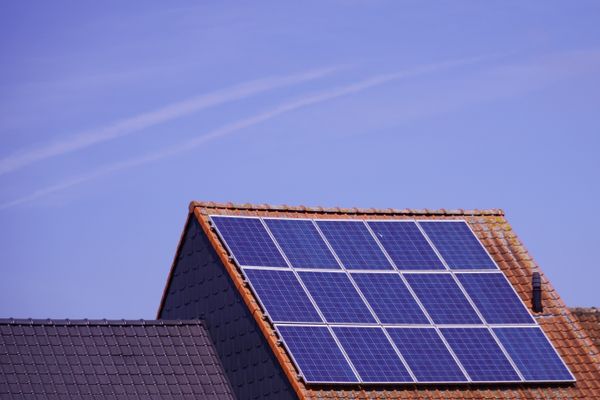
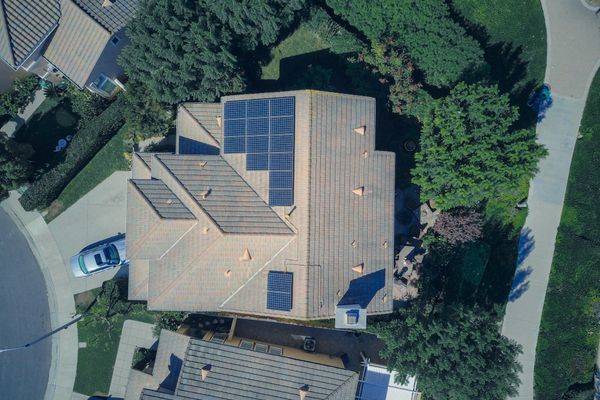
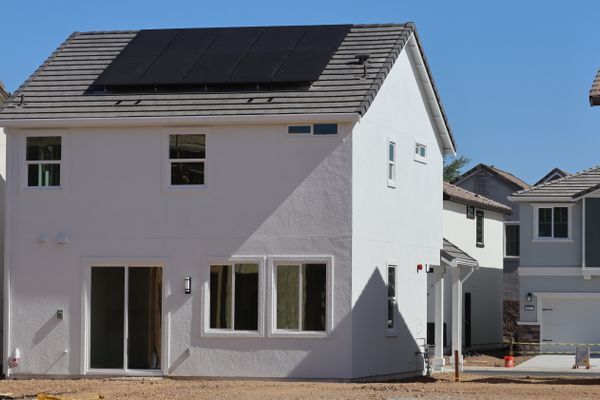
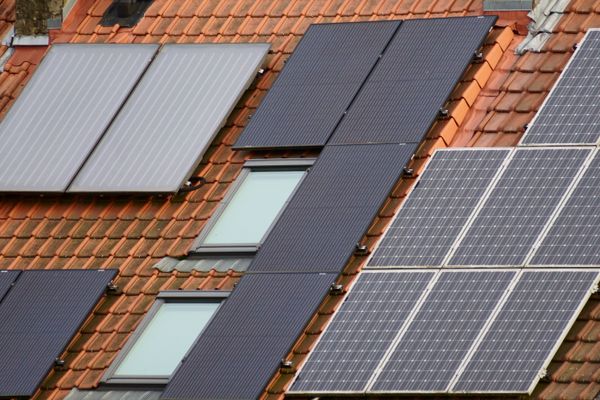
A domestic array is normally flush mounted, which places the rear of each module a short distance from a roof surface that is usually dark and always close. The reflected light available to the back of the panel is small to begin with, and most of it never reaches the cells because the mounting rails, the roof plane and the neighbouring modules block it.
On top of that, the roof isn’t the only obstruction. Rails, clamps, cable trays and the junction box itself all sit against the rear face. On a monofacial module none of that matters at all. On a bifacial one, every one of those items is shading an active surface, and shading on the rear behaves the same way shading on the front does, because the cells are still in series.
The practical result is that a bifacial module on a normal pitched roof gives back close to nothing for the extra cost. It isn’t harmful, and it may even be the cheapest module available in a particular market, in which case buying it is fine. Paying a premium for the bifacial property on a flush roof is not.
Where a household case does exist
The credible domestic setting is a flat roof with elevated racking over a light-coloured membrane. There the modules sit at a tilt with clear air behind them, the surface below reflects usefully, and the rear gain is genuine rather than theoretical. It is still smaller than the headline claims made for utility installations over high-albedo ground.
A carport, a pergola or any elevated open structure is the other case, and there the argument is often about the shading pattern beneath rather than the yield. Glass-glass construction is also more durable in some respects than glass-backsheet, which is a separate reason to consider it that has nothing to do with bifaciality.
A ground mount over grass falls somewhere in between and usually disappoints, because grass is a poor reflector and the rear gain in that setting is modest. If the ground beneath will be gravel or the location has long-lying snow, the number improves considerably.
Trackers gain real energy and cost real reliability
A tracker keeps the module pointed closer to the sun through the day, which reduces the cosine loss that a fixed panel accepts every morning and evening. The energy gain is genuine and can be substantial, and it is largest in clear, sunny climates where most of the irradiance arrives as a direct beam. In cloudy maritime conditions, where much of the light is diffuse and has no direction to aim at, the gain shrinks sharply.
What a tracker adds is a machine. Motors, gearboxes, bearings, controllers and cabling that flexes as the structure moves, all outdoors, all cycling every day for decades. It also adds wind loading, because a tilted moving surface presents a larger and more variable sail than a fixed flush array, and trackers must stow themselves flat in high wind, which requires the stow mechanism to work every time.
Utility installations accept that maintenance burden because they have staff, spares and a scale over which the fixed costs of a maintenance function are spread across thousands of trackers. A household has none of that. The same failure that is a work order on a solar farm is a specialist call-out and weeks of waiting on a private property.
The comparison that settles it
For almost any domestic budget, the alternative to spending on clever hardware is spending on more panels. Modules are the cheapest part of a modern installation per unit of capacity, and adding capacity is dull, reliable and requires no moving parts. Where roof area allows it, an extra panel or two will usually deliver more annual energy per unit of spending than either technology discussed here.
That reasoning doesn’t hold when area is the binding constraint. On a small roof already full, extra capacity is not available at any price, and technologies that extract more from a fixed area become worth a second look. Even then the honest ranking usually puts higher-efficiency conventional modules ahead of bifacial ones, because a flush roof cannot feed the rear face.
None of this makes either technology bad. Both are sensibly engineered responses to problems that exist at scale. The point is narrower and worth stating plainly: a technology can be excellent and still be the wrong purchase for a house, and a quotation that leans on either of these as a selling point for a pitched roof deserves scepticism.
Common questions
Would painting the roof white under the panels help?
On a flush-mounted array the gap is too small and too obstructed for reflected light to reach the cells, so the effect on generation is negligible. A lighter roof surface does reduce the temperature under the array, which helps a little through the temperature coefficient, but repainting a roof for that reason alone will not repay itself.
Is a seasonally adjustable tilt frame a cheaper version of tracking?
It captures a small part of the same gain without any of the moving parts, and it requires someone to go up and change the angle twice a year for decades. Most owners do it once. On a grid-connected system where a unit is worth much the same in any month, the recovered energy rarely justifies either the hardware or the climbing.
Do bifacial modules need special inverters?
No, they behave electrically like any other module, though the higher current under favourable rear illumination has to be accounted for in string design and fusing. The design consideration is real but routine, and it belongs to whoever sizes the strings rather than being a reason to avoid the technology.
Features writer, Power Your Roof
Radhika writes about solar basics, batteries, bills & tariffs, mostly the parts other people skip and is unreasonably interested in the detail nobody else checks.