Solar Basics
Judging an array that somebody else had installed
Inheriting a system with a house means assessing hardware of unknown age against records that may not exist, and a few things can be checked from the ground.
By Tara Mukherjee4 min read
The array has its own age
A system fitted to an existing building has a date of its own, and it is the number that matters most when judging what you are inheriting. Modules and inverters have different expected lives, so an array installed some years ago is not simply a slightly worn version of a new one. It is a system where one component has used up a large share of its life and the others have barely started.
Establishing the date is usually straightforward, since the inverter display or its label carries a manufacture date and the commissioning paperwork, where it survives, carries an installation date. Failing both, the meter or the network operator notification may record it.
Once you know the age, the rest of the assessment has a frame. Modules well into a warranty term with no visible damage are ordinary. An inverter of the same age is a component with a replacement in its near future, and that is a cost to anticipate rather than a fault to complain about.
What can be seen without going up
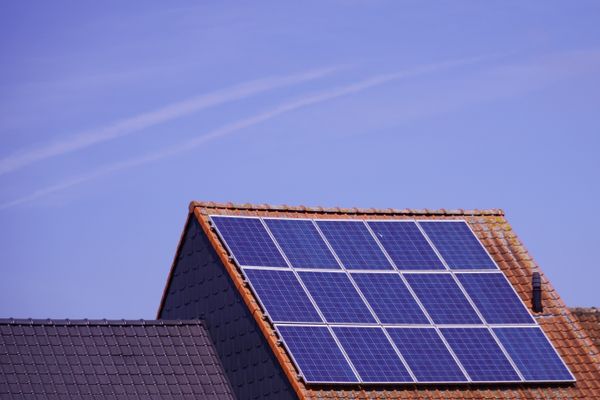
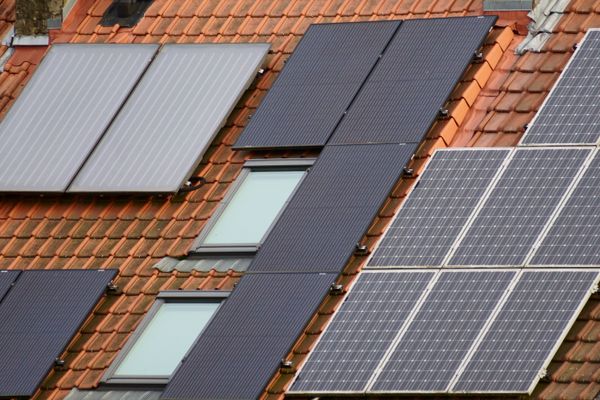
A surprising amount is visible from ground level with binoculars, and it is worth doing before anything else. Look for discoloration across cells, particularly browning of the material behind the glass, and for any panel that looks visibly different from its neighbours. Look for delamination, which shows as cloudiness or bubbling under the glass.
Then look at the frame and the mounting. Rails should be straight and evenly spaced, clamps should be present at every module, and nothing should sag. Cabling should be clipped up and running along the rails rather than looping down and resting on tiles, because a cable lying in a gutter of water or dragging on an abrasive surface will fail eventually.
Look at the roof itself while you are there. Plants growing at the array edge, slipped tiles beneath it, staining below a penetration, and moss packed between modules and tiles are all signs of a system that has been fitted and forgotten.
The inverter is the component with a known clock
Of everything in a domestic system, the inverter is the part most likely to need replacing within the array’s life, and it is the part with the clearest evidence of its condition. It is indoors or on a wall, it has a display, and it logs faults.
Switch it on and read the fault history if the interface allows it. Repeated grid-related events may be about the supply rather than the unit. Repeated internal temperature events suggest it is mounted somewhere too hot, which shortens its life measurably. Listen to it on a bright day; a loud fan on a mild afternoon is worth asking about.
It is fair to treat an old inverter as a foreseeable expense rather than a deal-breaker. Replacement is usually a straightforward job that doesn’t touch the roof. It is also a moment when the rest of the system gets inspected properly, which is not the worst outcome.
Ask for the data rather than the reassurance
The most useful thing a previous owner can hand over is a generation history. Where a monitoring platform is connected, several years of daily output tell you more than any inspection: whether production has held steady, whether a step change happened at some point, whether one string tracks lower than another.
A step down that never recovered normally indicates something specific, such as a failed optimiser, a bypass diode that stayed shut, or a string that came offline. A slow decline over many years is degradation and is expected. A pattern that varies wildly with the weather and averages steady is simply what solar looks like.
Where no data exists, the fallback is a sanity check on a clear day. Compare instantaneous output against the array size at the time of measurement, and expect a figure well below nameplate for all the reasons temperature and geometry impose. Anything dramatically below that, on a clear day with the sun on the panels, is worth investigating before completion.
What you cannot see, and what to ask for
The roof under the array is invisible, and that is where the most expensive faults hide. Nobody can tell you the condition of the fixings or the weathering detail at each penetration without lifting modules. What you can establish is whether the array was fitted by someone certified, whether the fixings suit the roof covering, and whether the roof was near the end of its life when the panels went on it.
Ask for the documentation set, because it answers several questions at once and its absence is itself information. Commissioning certificate, electrical installation certificate, network operator notification, module and inverter datasheets, warranty registrations and any structural sign-off. A complete file suggests a job done properly; a missing one does not prove the opposite but shifts the burden onto inspection.
One question is separate from all of this and should be asked first: who owns the array. Some systems on residential roofs are not owned by the householder at all but sit under a lease or a roof rental agreement, and that changes what is being sold entirely. It is a legal matter for a conveyancer rather than an engineering one, and it should be settled before anyone climbs a ladder.
Common questions
Is an array a liability or an asset when buying a house?
Owned outright, in good condition, with paperwork, it is an asset that reduces the electricity the building will import. Undocumented, ageing, or subject to a third-party agreement over the roof, it becomes a question for the conveyancer. The hardware is rarely the deciding factor; the paperwork usually is.
Should I get a specialist survey of the array?
For an older or larger system, an inspection by a qualified installer is proportionate, and it is cheap relative to a roof repair. Ask specifically for the mounting and weathering detail to be assessed, since that is what a general building survey will not cover and what costs most to put right.
What if the monitoring account belongs to the previous owner?
Ask for it to be transferred before completion, because retrieving it afterwards can be difficult and the historical data is genuinely useful. Failing that, most inverters can be re-registered to a new account, though the history may not follow. Get the inverter serial number and the monitoring platform name in writing.
Contributing editor, Power Your Roof
Tara writes about solar basics, batteries, bills & tariffs, mostly the parts other people skip and is happiest when a piece answers the question completely.