Bills & Tariffs
Kilowatts and kilowatt-hours are different products, and some bills charge for both
Confusing a rate with a quantity is the commonest error in household energy, and it hides both in tariff design and in the conversion arithmetic on a gas bill.
By Arjun Nair4 min read

A rate is not a quantity
A kilowatt is a rate of energy flow, like a speed. A kilowatt-hour is an amount of energy, like a distance. Running at one kilowatt for one hour delivers one kilowatt-hour, exactly as travelling at one kilometre per hour for an hour covers one kilometre, and the whole of household energy arithmetic follows from that relationship.
The confusion isn’t merely pedantic. A kettle drawing three kilowatts is a large load and a trivial consumer, because it runs for three minutes: roughly a seventh of a kilowatt-hour. A refrigerator drawing a small fraction of that is a much larger consumer, because it runs, in effect, all year.
Every argument about what to switch off comes down to multiplying power by hours, and the appliances that lose that multiplication are the ones that draw little and never stop.
Where a bill charges for the rate itself
Most domestic bills price energy alone, so the household pays for kilowatt-hours and the peak rate is somebody else’s problem. That isn’t universal. In a number of countries, domestic connections carry a capacity component priced on the size of the connection or on the highest power drawn during the billing period.
The logic behind it is sound, and it is the same logic that governs commercial tariffs. Networks are built to carry peaks rather than averages, and a household that draws a very high peak imposes more cost on the system than one drawing the same energy smoothly. Charging for capacity passes that cost back.
Where such a charge exists, the behaviour it rewards is different. It is no longer only about how much you use or when the price is low, but about avoiding coincidence: not running the oven, the shower, the dryer and the car charger in the same fifteen minutes. Load management devices exist mostly to serve this constraint.
The connection size is a limit and sometimes a price
Every supply has a rated capacity, set by the main fuse and the network connection behind it. In some markets that rating is chosen by the customer and priced accordingly, so a household can pay less by living within a smaller allowance. In others it is fixed by the network and free.
Where it is priced, the temptation is to buy a larger allowance for comfort, and it is usually the wrong call for a household with any load management at all. The peak that forces an upgrade is rarely a genuine simultaneous need; it is usually two heavy appliances that could easily have run twenty minutes apart.
Where it is not priced, the rating still matters because it caps what can be added. A house near its limit cannot simply install a large vehicle charger, and finding that out at the design stage is much less expensive than finding it out after the equipment is on the wall.
Gas is sold by volume and billed by energy
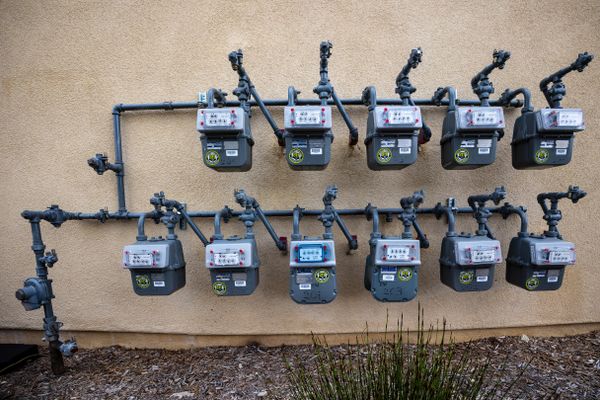
A gas meter measures the volume of gas that passed through it, in cubic metres or in hundreds of cubic feet depending on the meter’s age and country. Nobody buys volume, though, because what matters is the heat it releases, and that varies with composition.
So the bill applies a conversion: volume multiplied by a calorific value, adjusted for a correction factor accounting for temperature and pressure, divided to give kilowatt-hours. The calorific value is not invented for the bill; it is measured for the gas actually distributed in that area during that period, and it appears on the bill precisely so the arithmetic can be checked.
This is worth understanding for one practical reason. Comparing a gas bill against an electricity bill, or against a heat pump proposal, requires both to be expressed in the same units of energy, and the conversion is where errors creep in. Compare kilowatt-hours against kilowatt-hours and the comparison becomes honest.
Reading a bill as three separate things
A useful habit is to decompose any bill into three parts before drawing conclusions. There is a fixed element that arrives regardless of usage. There is a variable element proportional to energy consumed. And there may be a capacity or demand element related to the rate at which it was consumed.
Each responds to different action. The fixed part responds to nothing except changing supplier or disconnecting entirely. The variable part responds to using less and, under time-varying pricing, to using it at different hours. The capacity part responds only to spreading loads apart.
Doing this before evaluating a solar or storage proposal prevents a common disappointment. A system that displaces energy has no effect whatsoever on the fixed part, so a quotation that compares its output against the total bill is overstating what it will do, and the arithmetic looks quite different once the fixed element is set aside.
Common questions
Why is my electricity meter reading in units rather than kilowatt-hours?
On an electricity meter a unit is a kilowatt-hour; the terminology is historical and the two words describe the same quantity. Gas is where the distinction bites, since the meter counts volume and the bill converts it, which is why a gas meter reading and the billed figure look nothing like each other.
Is it worth reducing my main fuse rating to save money?
Only where the tariff genuinely prices capacity, and only after checking what the household actually draws at its busiest. The saving is real in those markets and so is the risk of nuisance tripping on a winter evening. It is also the kind of change that has to be done by the network operator rather than by an electrician.
Does a solar system reduce my peak demand?
Only if the peak happens when the sun is up, which in most households it does not, since the peak tends to fall in the evening. A battery can shave an evening peak, and that is one of the few cases where storage has a clear value independent of the price of energy. Where the tariff has no capacity component, none of this affects the bill at all.
Staff writer, Power Your Roof
Arjun has been reporting on solar basics, batteries, bills & tariffs since long before it was fashionable and thinks most subjects are more interesting once you know how they work.