Bills & Tariffs
What your metering arrangement is actually counting
The physical arrangement at the boundary decides whether generation, export and import are measured separately or netted, and old meters can get it badly wrong.
By Manish Trivedi3 min read
One boundary, several possible arrangements
Everything about a bill starts at the point where the property connects to the network. A meter sits there, and what it records defines what can be billed and what can be paid. Before solar, the arrangement was simple: energy flowed one way, and one register counted it.
Generation on the premises breaks that simplicity, because energy now flows in both directions at different times of day. The arrangements that have grown up to handle this differ between countries, between suppliers and between the decade in which the meter was installed, and they aren’t equivalent to one another.
Understanding which arrangement you have isn’t academic. It determines whether a unit sent to the grid is worth the same as a unit taken from it, and that single fact drives most of the economics of a domestic system.
Net metering, and metering separately
Under a true net arrangement, the meter counts the difference between what flowed out and what flowed in, over a settlement period. A unit exported at noon cancels a unit imported at eight in the evening exactly, which makes the grid behave like a lossless battery of unlimited size and makes solar extremely attractive.
Under separate metering, import and export are recorded on their own registers and priced independently. The exported unit is worth whatever the export arrangement pays, the imported unit costs whatever the import tariff charges, and the two are almost never equal. This is the more common arrangement in newer schemes, and it is the reason self-consumption became the number worth optimising.
A great many places sit in between, netting over an interval and then treating any remaining surplus separately. The length of that interval is the crucial detail. Netting over a month behaves almost like true net metering; netting over half an hour barely does at all.
Generation meters measure something different again
Some schemes pay for total generation regardless of where it goes, which requires a second meter placed between the inverter and the house rather than at the boundary. That meter counts every unit the system produces, including the ones consumed inside the property that never reach the network.
Where both meters exist, they answer different questions and their readings will not match. The generation meter tells you how the array is performing. The boundary meter tells you what crossed to and from the network. The difference between them is your self-consumption, which is a useful figure that most households never calculate.
There is also the deemed arrangement, in which export is not measured at all but estimated as a fixed proportion of generation. It is administratively simple and it can be generous or mean depending on your actual pattern, and it removes any incentive to increase self-consumption, which is a strange result worth being aware of.
Old meters can count export as import
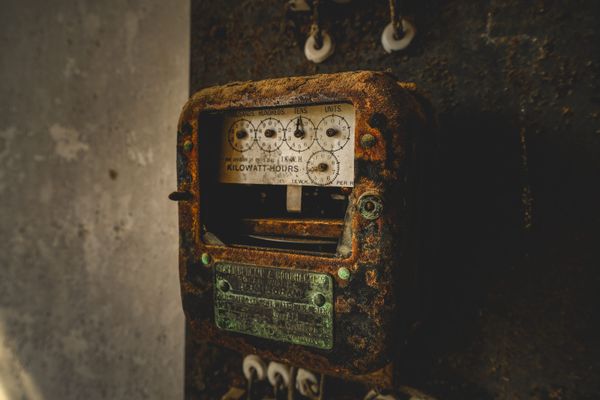
This is the failure that genuinely costs households money. Some older electronic meters, on encountering current flowing in the reverse direction, register it as consumption rather than as export. The result is a household paying to give electricity away, and the meter shows no sign of anything unusual.
Older electromechanical meters have the opposite quirk. A rotating disc can turn backwards under reverse flow, quietly crediting the customer, which is why suppliers replace them when generation is installed. Neither behaviour is a scandal; both are artefacts of equipment designed for a world where power flowed one way.
The protection is simple. Before commissioning, establish that the meter is suitable for a property with generation, and after commissioning, watch the import register on a bright day when the house is exporting. If it climbs while the inverter is exporting, something is wrong and it needs raising with the supplier immediately.
Phases, and the netting nobody mentions
On a three-phase supply the question arises of whether the meter nets across the phases or treats each one separately. If a single-phase inverter exports on one phase while the house consumes on another, a meter that sums the phases sees the offset and a meter that doesn’t will bill the import and pay for the export separately.
Practice varies by country and by meter type, and the difference is not small for a household with a three-phase supply and single-phase generation. Where the meter does not net, spreading loads across phases, or specifying a three-phase inverter, becomes worth real money.
It is worth asking the question before the system is designed, because the answer may change what inverter you should buy. Very few sales conversations raise it, and it is one of the more consequential details hiding inside an otherwise unremarkable connection.
Common questions
How do I find out which arrangement I have?
The bill and the connection agreement between them will say, and the meter itself usually cycles through its registers on the display. If there is a register accumulating units in an export direction, export is being measured. If there is only one register and it only ever rises, netting or deeming is in play, and the supplier can confirm which.
Can I add a second meter myself to check?
You can install monitoring equipment inside the property, and it must not interfere with the supplier’s meter or its seals, which are legally protected in every jurisdiction. Clamp-based monitors on the incoming tails are the usual approach, and they are a good sanity check against the billed figures rather than a substitute for them.
Does exporting affect my import tariff options?
Sometimes, because not every tariff is offered to properties with generation, and some export arrangements are tied to buying import from the same supplier. This coupling is a genuine constraint in several markets, and it is worth checking before signing an export agreement that quietly limits which import tariffs remain available to you.
Deputy editor, Power Your Roof
Manish has been reporting on solar basics, batteries, bills & tariffs since long before it was fashionable and would rather show the working than assert the conclusion.