Installation
Connectors and cable routing cause more roof faults than modules do
The plugs joining panels together are the smallest components in the system and the most frequently implicated when something on the roof stops working properly.
By Kabir Anand4 min read

A small plug with a large job
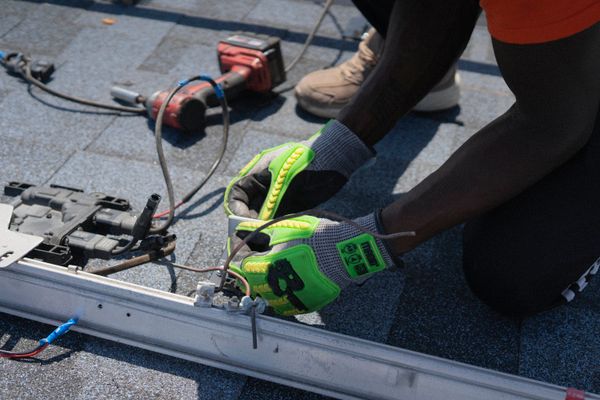
Every module leaves the factory with two cables ending in a matched pair of plugs, and the array is assembled by pushing those together. It is a neat system that turns a wiring job into an assembly job, and it is why a roof can be strung together quickly by a crew working in awkward positions.
What the connector has to achieve is not trivial. It must carry current continuously for decades, stay sealed against rain and driven water, tolerate ultraviolet exposure and a wide temperature range, and remain mechanically secure while the array expands and contracts around it. All of that in a plastic body the size of a thumb.
Mostly they manage it. When they don’t, the failure is usually traceable to how they were installed rather than to the part itself.
Mixing brands is the classic mistake
Connectors from different manufacturers frequently look identical and will click together satisfyingly, which is the trap. They are not necessarily made to the same tolerances, and a pair that mates mechanically may make contact over a smaller area than either was designed for, or may not seal properly against water.
A poor contact does not fail immediately. It heats slightly under load, that heat degrades the contact further, and the process continues quietly for months or years. The connection between two products that were never tested together is exactly where this begins.
It happens because a crew ran short of one type, or because a replacement module came with different plugs, or because two systems were joined by different companies at different times. Manufacturers are explicit that mating dissimilar connectors is outside their approval, and it is one of the few areas where the rule is genuinely unambiguous.
Field-fitted connectors depend entirely on the crimp
Where a cable has to be cut and a new connector fitted on site, the electrical quality of that joint is decided by a crimp made with the correct tool and die for the conductor size. A crimp made with pliers, or with a generic tool, produces a joint that looks the same and behaves worse.
The seal is decided by whether the gland was tightened onto the right cable diameter with the right sealing insert. A connector fitted to an undersized cable will pass water eventually, and the water travels along the conductor rather than staying where it entered.
This is work with a right way and a wrong way that are visually indistinguishable once done, which is precisely why the tooling matters and why it isn’t an owner task.
Cables that are left to hang do not stay where they were left
The gap beneath an array is a hostile place for a loose cable. Wind moves it, and repeated movement abrades the sheath against a rail edge or a roof fixing until the insulation is compromised. Sunlight reaches surprisingly far under a panel at low sun angles and degrades any sheath not rated for it.
Good practice is to support cables clear of the roof covering, secure them at intervals with fixings intended for outdoor use, and leave enough slack that nothing is under tension while avoiding loops that dangle. Cable ties chosen for indoor use go brittle and release their grip within a few years, which is a common finding on older installations.
Water is the other consideration. Cables should be routed so that any water running along them drips off before reaching a connector, rather than being led into one, and connectors should not sit in a position where water collects.
What this looks like when it goes wrong
A degrading connection shows up first as a string producing slightly less than its neighbour, or as intermittent output that comes and goes with temperature or with rain. Per-module monitoring makes this obvious. Without it, the loss can hide inside ordinary weather variation for a long time.
The more serious outcomes involve heat at the connection, and they are a genuine hazard on a direct-current circuit that cannot be switched off from the ground. That is a matter for a qualified installer and not for investigation by the owner, and the correct response to suspected overheating on a roof is to have the system isolated by someone competent.
Discolouration or distortion visible on a connector is not a maintenance item to monitor. It is a reason to call somebody.
What an owner can reasonably do
At the point of installation, ask whether all connectors in the system are from the same manufacturer, and get the answer recorded. Where a system is being extended or repaired later, raise it again, because that is when mismatches are introduced.
After the scaffolding leaves, a look from the ground with binoculars will show whether cables are hanging loose beneath the array or dressed properly along the rails. It is a crude inspection and it catches the most common workmanship failure.
Beyond that, this is a category of fault best found by monitoring rather than by looking. A system reporting per-string or per-module data will show a degrading connection long before anything is visible.
Common questions
Are all solar connectors interchangeable?
They are not, even when they appear identical and click together. Different manufacturers build to their own tolerances, and a mated pair from two different makers is outside what either has tested and approved. Where a repair or extension requires joining to existing cabling, the correct approach is to match the existing type or to replace both halves of the connection.
Can I fit a solar connector myself?
It is not recommended, and in many jurisdictions work on the array circuits requires a qualified person. The joint depends on a crimp made with the specific tool for that connector and conductor, and on a gland sealed onto the correct cable diameter, neither of which can be judged by looking at the finished result. The circuit is also live whenever there is daylight.
How long do connectors last?
A correctly specified and correctly fitted connector is expected to last as long as the array, since that is what it is designed and tested for. The failures that occur in the field are overwhelmingly the result of mismatched types, poor crimps, damaged seals or mechanical strain rather than of the component reaching an age limit.
Consumer editor, Power Your Roof
Kabir covers solar basics, batteries, bills & tariffs and the questions readers actually send in and is happiest when a piece answers the question completely.