Installation
Putting an array over a planted roof or a usable terrace
A green roof and a solar array can help each other, and a terrace and an array mostly compete, and both cases turn on access and drainage rather than on generation.
By Manish Trivedi4 min read
Two claims on one horizontal surface
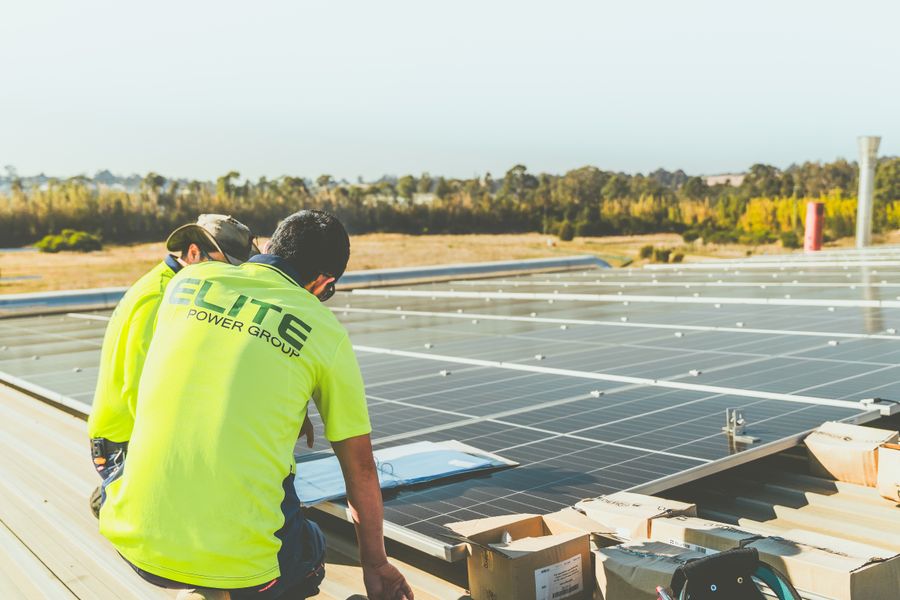
A flat roof is the most contested surface on a building. It can carry plant, an array, a planted covering, a terrace, a route for maintenance access, and the future need to recover the whole thing, and all of those want the same square metres. On a pitched roof the array is the only realistic claimant. Up here it is one of several.
That makes the interesting questions spatial and organisational rather than electrical. Where do people walk. Where does water go. What has to be reached, and how often.
The generation side is comparatively straightforward, since a flat roof allows the array to be oriented and tilted more or less freely.
A planted roof and an array genuinely suit each other
Vegetation and its growing medium hold water and lose it through evaporation, and that process cools the surface around it. Since a photovoltaic module produces less as it heats, an array sitting above a planted roof tends to run cooler than the same array above a dark membrane in the same sun, and produces slightly more for it.
The relationship works in the other direction too. Partial shade from the modules creates a more varied microclimate at plant level, with sheltered and exposed zones, which usually increases the range of species that establish rather than reducing it.
The effect on generation is modest and it is real. It isn’t, on its own, a reason to build a green roof, and any proposal that leans on it heavily is overstating a secondary benefit.
The build-up underneath changes the mounting problem
A planted roof already carries a substantial load in its growing medium, particularly when saturated, and adding an array on top requires the structure to be assessed for both together. That is an engineering question for a qualified professional and it should be settled before anything is designed.
The mounting itself is usually ballasted or raised above the build-up on bases that spread the load, and it has to sit above the level the vegetation will reach at maturity. Plants growing into the underside of an array shade it, hold moisture against it, and turn a maintenance task into an annual one.
Roots and membranes are the other consideration. A planted roof depends on a root barrier and on a drainage layer, and any fixing that passes through those layers is a penetration through the waterproofing of a roof that is much harder to inspect than a bare one. Systems designed for this application exist precisely to avoid that.
Drainage and maintenance access are what actually go wrong
Flat roofs drain to a small number of outlets, and those outlets have to be reachable and clear. An array laid across a roof without regard for them creates a maintenance job that involves crawling under panels, which means it will not be done reliably, and a blocked outlet on a flat roof is a structural loading problem rather than a nuisance.
Vegetation makes this sharper, because a planted roof sheds organic material continuously. Leaving clear zones around outlets and along inspection routes is standard practice and it costs array area, which is a trade worth making deliberately at design stage rather than regretting later.
The same argument applies to anything else on the roof: vents, rooflights, plant, and the panels themselves, which need to be reachable if one ever has to come off.
A terrace is a harder case and often the wrong roof
A roof that people use is a roof where an array is in the way. Panels at a workable tilt obstruct the space, the space cannot be given over to them without losing its purpose, and the compromise arrangements — panels around the edges, panels raised overhead as a canopy — are either small or structurally significant.
The overhead canopy version can work well and is a real building element rather than a solar accessory. It has to resist wind uplift acting on a structure people stand beneath, it has to deal with water running off the panels somewhere sensible, and it needs designing accordingly. That is a project with an architect and an engineer in it.
Where a terrace is genuinely used and enjoyed, it is usually better to accept that the roof is not an array site and to look elsewhere on the building. A publication that pretends every surface should carry panels isn’t being useful.
Deciding which use wins
The honest test is what the roof is for. A planted roof that exists for drainage, insulation or biodiversity gains an array comfortably, provided the structure takes the load and the layout preserves access. A terrace that exists to be occupied loses more than it gains in most arrangements.
Everything else is a matter of getting the sequence right. Structural assessment first, then waterproofing strategy, then access and drainage layout, and only then the array design. Reversing that order is how a flat roof project acquires an expensive surprise.
Common questions
Does a green roof really improve solar output?
Slightly, through evaporative cooling of the surface beneath and around the modules, which reduces cell temperature and therefore improves output a little. The effect is modest and varies with climate, planting and how much clearance sits between the panels and the vegetation. It is a genuine bonus rather than a reason to build one.
Can panels be fixed through a green roof without leaking?
Penetrating a planted roof means passing through a root barrier, a drainage layer and the waterproofing, in a position that is subsequently buried and hard to inspect. It can be detailed properly and it usually is not the preferred approach. Ballasted or raised systems designed for planted roofs avoid the penetration altogether, which is why they are the normal solution.
How much clearance should there be between panels and planting?
Enough that mature planting cannot reach the modules and that maintenance can be carried out underneath, which depends entirely on what has been planted. A low sedum covering needs far less than a meadow mix. The figure should come from whoever specified the planting rather than from the solar installer, and it is worth agreeing before the mounting height is fixed.
Deputy editor, Power Your Roof
Manish has been reporting on solar basics, batteries, bills & tariffs since long before it was fashionable and would rather show the working than assert the conclusion.