Installation
A solar roof changes how a fire is fought
Pulling the main switch leaves the array and its cables live, which is why fire services approach a building with panels differently and why a few design choices matter to people you will never meet.
By Radhika Iyer4 min read
The main switch does not reach the roof
Almost every electrical emergency in a house ends the same way: someone finds the main switch and everything stops. A solar array breaks that assumption entirely, and the break is physical rather than procedural. Panels generate whenever light falls on them. There is no switch inside a module, no standby state, and no way to make it stop except by removing the light. Opening the main switch disconnects the inverter from the grid, which is important and necessary, and does absolutely nothing to the conductors running from the roof to that inverter. They remain live.
A firefighter’s training in most countries now covers this specifically, and the outcome is that a building with an array is approached with different assumptions. Cutting the supply no longer means the building is dead. The roof, the cable route and anything that route passes through are treated as energised until someone competent has established otherwise.
What module-level shutdown does, and what it cannot do
Several jurisdictions now require devices that reduce the voltage on conductors outside the array boundary when a signal is lost or a control is operated. Depending on the design these sit behind each module or each pair of modules.
What this achieves is worth stating precisely. It brings the long run of high-voltage cable between the roof and the inverter down to something much less dangerous, which is exactly the cable that passes through the building and the cable a firefighter is most likely to encounter. That is a real and significant safety gain.
What it does not do is stop the modules generating. Each panel is still producing its own voltage internally, the array area itself is still live, and a module that has been physically damaged may present hazards that no shutdown device controls. The technology reduces the hazard along the route. It does not remove it at the source, and no honest description of it claims otherwise.
Access across the roof is part of the design
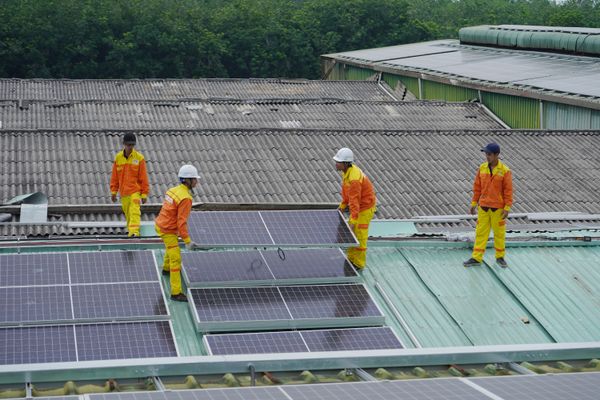
Ventilating a roof — cutting an opening to let heat and smoke out — is a standard tactic in structural firefighting, and it depends on being able to get onto the roof and work on it. An array that covers a roof plane edge to edge removes that option, and it removes it at the moment it is most wanted.
For this reason several building and fire codes specify setbacks from ridges and edges, and clear pathways between arrays, so that a crew has somewhere to stand and somewhere to cut. These requirements are far from universal; in many countries there is nothing of the kind, and the design fills the roof because nothing prevents it.
There is a straightforward tension here, since every square metre given to a pathway is a square metre that does not generate. Where the rules exist they are mandatory; where they do not, the trade is a judgement about a rare event. Worth asking the installer which situation applies locally.
Labelling exists for someone arriving in the dark
Signage on a solar installation looks like bureaucracy and is nothing of the kind. A placard at the meter position or the main intake tells someone who has never seen the building before that there is an array, that direct-current conductors are present, and where the isolation points are. That is information they cannot otherwise obtain in the time available.
The same applies to a single-line diagram showing the cable route, the isolators and the position of any battery, which is arguably the single most useful fact in the document because a lithium system in thermal runaway changes the tactics entirely. All of which is useless if the paperwork lives in a folder in a loft. The labelling at the intake is the part that does the work, and it should still be legible years after anyone has thought about it.
Where the risk actually comes from
It is worth being proportionate. Photovoltaic modules do not spontaneously ignite; the materials are glass, aluminium, silicon and polymer laminate, and none of it is enthusiastic about burning. Arrays aren’t a common origin of house fires, and the panic that occasionally attaches to them is out of proportion to the evidence.
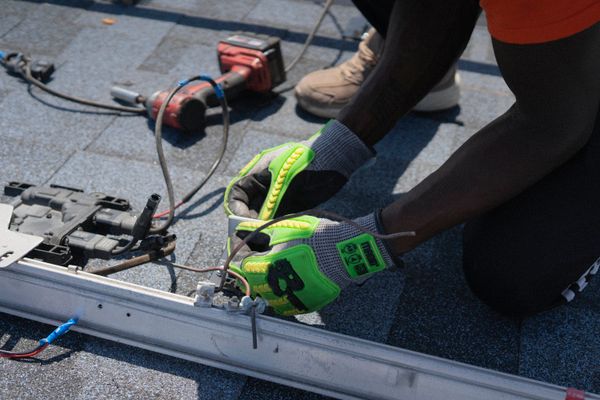
Where ignition has been traced to a solar installation, the cause is almost always a connection rather than a component. Plug connectors from different manufacturers mated together because they physically fit, crimps made with the wrong tool, conductors clamped over insulation, cable resting on a sharp edge for years — these are workmanship failures, and they generate heat at a point nobody inspects.
That is an argument for caring about installation quality rather than for avoiding solar, and it is why the direct-current side attracts so much attention in the standards.
What an owner should and should not do
In an actual emergency the answer is short. Leave, call the fire service, and tell them on arrival that the building has an array, roughly where it is, and whether there is a battery. Do not go looking for the direct-current isolator, and don’t attempt to disconnect anything on the roof.
Beforehand, the useful preparation is unexciting. Know where the isolation points are, keep the documentation reachable rather than clever, and have faded labelling replaced. If a smell of hot plastic, discoloured cabling or a tripping inverter suggests a bad connection, treat that as urgent. Everything specific here — shutdown devices, setbacks, what must be labelled — is set by the building and wiring rules where you live, and they differ considerably between countries. Ask a qualified installer working to those rules.
Common questions
Will the fire service refuse to put out a fire in a house with solar?
No. Crews are trained to work on buildings with arrays and do so routinely. What changes is the tactics: the roof may be treated as an electrical hazard rather than a working platform, and certain approaches may be ruled out. Clear labelling and accessible documentation help them make those decisions quickly.
Should I fit shutdown devices if my country does not require them?
It is a reasonable option to discuss with an installer, and it has a modest cost and a small ongoing complexity, since each device is an additional electronic component on the roof that can itself fail. Some owners consider the reduced hazard along the cable route worth it. Others reasonably conclude that a well-executed installation with a short, well-protected cable run is sufficient.
Does a battery make the fire risk worse?
A lithium battery represents a genuinely different hazard from an array, because a cell in thermal runaway produces its own heat and its own gases and is difficult to extinguish rather than merely dangerous to touch. This is why placement, ventilation and separation from escape routes are governed by specific rules, and why telling a crew where the battery is matters.
Features writer, Power Your Roof
Radhika writes about solar basics, batteries, bills & tariffs, mostly the parts other people skip and is unreasonably interested in the detail nobody else checks.