Installation
Earthing an array is about fault current, not about lightning
The green wire running back from the mounting rails exists so that a fault has a defined path and a metal frame cannot become dangerous to touch, which is a different job from suppressing a surge.
By Tara Mukherjee4 min read
Two protective ideas that share a wire
Protective earthing gives a fault current somewhere to go. If a live conductor comes into contact with metalwork that people can touch, the earth connection provides a low-resistance route back to the source, so a large current flows and the protective device upstream disconnects the circuit quickly.
Equipotential bonding does something subtly different. It ties exposed metal parts together so that they sit at the same voltage as each other, which means that even during a fault there is no meaningful difference between two things a person might touch simultaneously. One is about clearing the fault. The other is about what happens in the moment before it clears.
Both are separate from surge protection, which handles brief high-voltage transients and is a topic in its own right. The wires may share a route. The purposes do not overlap.
A metal frame on a roof is exposed conductive part
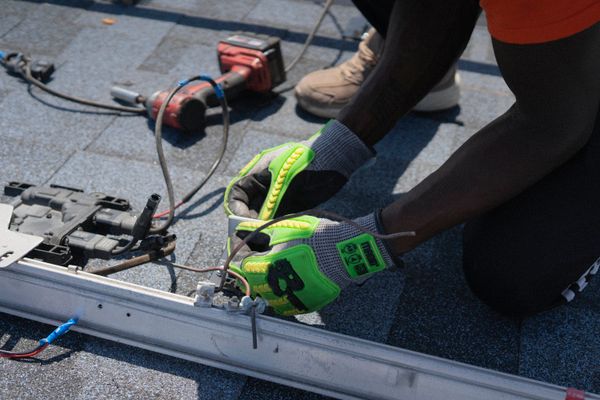
An array brings a quantity of aluminium and stainless steel onto a building and runs live cables through it. If insulation fails anywhere in that assembly, the frame can become live, and it is connected to a roof that people occasionally walk on and to rainwater that runs off it.
That is why the mounting structure is bonded rather than left floating, and why the bonding conductor is sized and routed according to the local wiring rules rather than by eye. The requirement varies between countries and between system types, and there are configurations where a frame is deliberately not earthed because the equipment is built to a class of insulation that makes it unnecessary.
This is precisely the sort of detail that looks like a preference and is actually a rule. It belongs to the designer and the installer, and the correct thing for an owner to do with it is check it was addressed rather than form an opinion about it.
Direct-current circuits complicate the picture
On the alternating-current side of the house, the protective arrangements are familiar and standardised, and the devices that detect faults are common equipment. The array side behaves differently, because the source is a set of panels that cannot be switched off and that supply a limited current no matter what happens.
A short circuit in a solar string does not produce the large fault current that trips a breaker. It produces something close to the current the panels were already delivering, which is why relying on overcurrent protection to detect a fault on that side does not work in the same way. Insulation monitoring within the inverter is the usual answer.
The practical consequence is that earthing on the array side is doing more of the work, because the automatic disconnection that protects the rest of the house is less effective there.
More electrodes is not more safety
It is tempting to think of earthing as a connection to the ground and therefore to imagine that driving another rod in near the house adds protection. Sometimes it does. Sometimes it introduces a second reference point at a different potential from the first, and creates exactly the voltage difference that bonding exists to eliminate.
How the building is earthed at the incoming supply is determined by the network arrangement in your country, and that arrangement dictates what may and may not be added. Certain supply configurations place real restrictions on additional electrodes and on bonding to external metalwork.
Nothing about this is guessable from first principles, and it is not a place for improvisation. A qualified electrician working to the local rules is the only reasonable route.
What an owner can sensibly verify
The commissioning documentation should record that earth continuity was tested and what result was obtained, and it should show the arrangement as designed. A visual check that a bonding conductor actually reaches the array structure, rather than stopping at the inverter, is within reach of a careful person from the ground or a loft hatch.
Corrosion is the long-term issue. A bonding connection made between dissimilar metals, or one left without protection in a wet position, can degrade over years while the system continues working perfectly, because nothing depends on it until the day something goes wrong.
That is the awkward property of protective measures generally. They are invisible when working, invisible when failed, and only distinguishable by inspection.
Where it sits in a decision about an installation
None of this should influence which panels you buy, and it will not appear in a sales conversation. It appears in the design document and in the certificate, and its presence there is a reasonable proxy for whether the rest of the work was done to a standard.
If a quotation contains no reference to earthing arrangements at all, that is worth a question. Not because the answer will mean much to you, but because an installer who can answer it clearly is telling you something about how they work.
Common questions
Does every solar array have to have its frame earthed?
Not universally, and it depends on the equipment class, the system configuration and the wiring rules where you live. Some installations are designed so that the frame does not require an earth connection, and adding one incorrectly can create problems rather than solve them. It is a decision for the designer working to local standards, not a default.
Is earthing the same as having a surge protective device?
No. Earthing provides a route for fault current and keeps touchable metalwork at a safe potential, while a surge protective device diverts brief high-voltage transients away from equipment. A surge device relies on a good earth to function, so the two are related, but fitting one does not substitute for the other.
Can I add an earth rod myself to improve safety?
This is not owner work, and it can make things worse. Whether an additional electrode is permitted, and how it must be connected, depends on how your incoming supply is earthed, and getting it wrong can introduce a potential difference between metal parts. Any change to a building’s earthing arrangement is a job for a qualified electrician.
Contributing editor, Power Your Roof
Tara writes about solar basics, batteries, bills & tariffs, mostly the parts other people skip and is happiest when a piece answers the question completely.